


In today’s competitive landscape, businesses are expected to move quickly, adapt constantly, and deliver results without delays.
Not long ago, developing software required heavy investment—both in time and technical expertise. But things have changed.
Low-code platforms are reshaping how companies build digital solutions, making it possible to create applications faster, with fewer resources, and without relying entirely on traditional coding.
So, how do these platforms work—and how can they actually help your business grow?
What Is Low-Code Development?
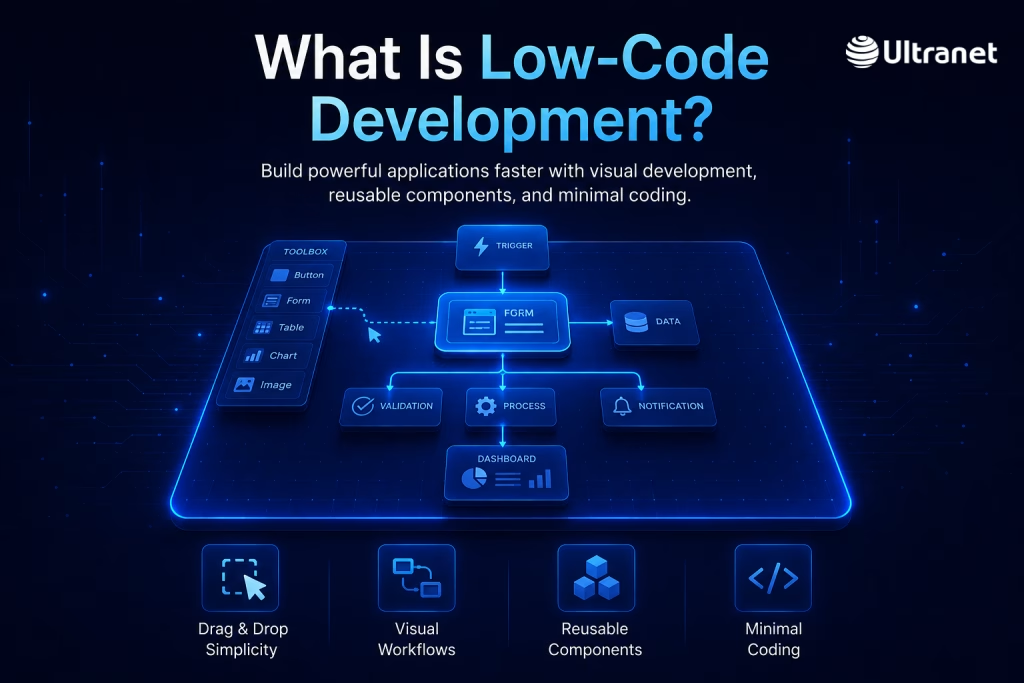
Low-code development is a modern approach to building applications with minimal manual programming.
Instead of writing complex code line by line, users can create systems using:
- Visual interfaces
- Drag-and-drop tools
- Pre-built components and templates
This approach simplifies development, making it faster and more accessible—not just for developers, but also for business users with limited technical knowledge.
Why Low-Code Is Gaining Popularity

Traditional software development can be slow and resource-heavy. Low-code platforms streamline the process, allowing businesses to:
- Launch applications faster
- Reduce dependency on specialised developers
- Experiment and iterate more easily
- Scale solutions as the business grows
In short, low-code removes many of the barriers that used to slow innovation.
Key Features That Make Low-Code Powerful

Low-code platforms are designed for both speed and flexibility. Some of their most important features include:
Visual Development Environment
Instead of coding everything manually, users can design applications through intuitive drag-and-drop builders and workflow editors.
Pre-Built Modules
Common features are already available as reusable components, saving time and effort during development.
Seamless Integrations
Most platforms allow easy connection to APIs, databases, and third-party tools, helping businesses link new apps with existing systems.
Rapid Prototyping
Ideas can be built and tested quickly, making it easier to gather feedback and refine solutions before full deployment.
Team Collaboration
Multiple team members can work together on the same project, improving communication and speeding up delivery.
Scalable Solutions
Despite being fast and simple, many low-code platforms can support large-scale, enterprise-level applications.
The Business Benefits of Low-Code Solutions

Low-code isn’t just about convenience—it delivers real advantages for organisations.
Faster Launch Times
Applications can go from idea to deployment much quicker compared to traditional development methods.
Improved Productivity
Teams spend less time on repetitive coding and more time solving real business challenges.
Reduced IT Bottlenecks
Non-technical users can contribute to development, easing the workload on IT departments.
Greater Flexibility
Businesses can adapt systems quickly in response to market changes or new opportunities.
Cost Savings
Shorter development cycles and reduced reliance on specialised coding help lower overall costs.
Wider Participation
More employees can be involved in digital projects, encouraging collaboration and innovation.
8 Practical Ways Low-Code Can Support Business Growth

Low-code platforms can be applied across many areas of a business. Here are eight key use cases:
1. Rapid Application Development
Low-code tools are ideal for quickly building and launching applications, allowing businesses to respond faster to new opportunities.
2. Customer Relationship Management (CRM)
Low-code CRM systems help manage customer data, sales pipelines, and interactions while allowing easy customisation of workflows.
3. Enterprise Resource Planning (ERP)
From finance to HR and inventory, low-code ERP solutions simplify complex operations with flexible, customisable modules.
4. Business Process Automation
Repetitive manual tasks can be automated, reducing errors and freeing up time for more strategic work.
5. Mobile App Creation
Businesses can develop mobile applications faster without heavy coding, making it easier to reach users on smartphones and tablets.
6. Content Management Systems
Low-code CMS platforms allow teams to manage website content easily, keeping digital channels updated and relevant.
7. Data Analytics and Reporting
Low-code tools simplify the creation of dashboards and reports, helping businesses turn data into actionable insights.
8. Internet of Things (IoT) Applications
Companies can connect devices, monitor performance, and analyse data more easily, opening up new opportunities for innovation.
Final Thoughts
Low-code development is changing the way businesses approach technology.
By simplifying the development process and making it more accessible, these platforms allow organisations to innovate faster, improve efficiency, and scale more effectively.
Whether you want to automate workflows, build applications, or gain better insights from your data, low-code solutions provide a practical and flexible way to move forward.
In a world where speed and adaptability matter more than ever, low-code is no longer just an option—it’s becoming a competitive advantage.
Frequently Asked Questions (FAQ)
1. What is low-code development?
Low-code development is an approach to building applications using visual interfaces, drag-and-drop tools, and pre-built components instead of relying entirely on manual coding. It helps businesses develop digital solutions faster and with fewer technical resources.
2. What are the main benefits of using low-code platforms?
Low-code platforms can help businesses reduce development time, improve productivity, automate repetitive processes, lower development costs, and make it easier to update or scale applications as business needs change.
3. Can low-code platforms be used to build business systems?
Yes. Low-code platforms can be used to develop solutions such as CRM systems, ERP systems, workflow automation tools, dashboards, internal management systems, mobile applications, and other business applications.
4. Is low-code suitable for small and medium-sized businesses?
Yes. Low-code can be particularly useful for SMEs because it allows them to build and launch digital solutions without requiring a large development team. It can also help businesses test new ideas before investing in more complex custom development.
5. Does low-code completely replace traditional software development?
Not necessarily. Low-code is suitable for many business applications, but highly complex systems, advanced integrations, or specialised requirements may still require traditional coding. In many projects, low-code and custom development can be used together depending on the business requirements.